I am Gilles Comeau, I am a professor at the School of Music at the University of Ottawa. I am the founding director of the Music and Health Research Institute at the University of Ottawa, and recently I became a principal researcher at the Research Institute in Mental Health at the Royal, where I am responsible for establishing a research clinic in music and mental health.
There is a lot of research that tends to demonstrate that music can have an impact on several health conditions, on well-being, on mental health. I observed in the report that was published in 2019 by the World Health Organization that approximately 40% of music research had been done with music therapists, and that the other 60% was by musicians, musician-educators, sometimes health people who had music training.
At that time, I knew there was lot of research that had been done with music therapists, that look at how their work was having an impact. And music therapists often work one-on-one, and often see themselves as health practitioners who are working towards helping individuals with certain condition. So I decided at that time to put the focus on musicians and music educators, because a lot less research has been done in that area.
They were already very much implementing their programs in health and social settings, so I wanted to be able to study what was happening and see how I could contribute with better engagement of musicians and music educators, for the health and wellbeing of individuals and communities.
Gilles Comeau: On the impacts of music and health and strategies for measuring these impacts
For people who have dementia, it really has an impact on their well-being and quality of life. Because we understand that music is not expected to have a healing impact on Alzheimers condition, but, really has a significant impact on well-being and quality of life. Even for people who suffer from depression and anxiety, it is also about being able to make the symptoms less disturbing, and being able to improve well-being.
So what we do is that we try to measure how it has an impact on their well-being: measure the impact on anxiety, measure the impact on depression, measure the impact on the joy / the excitement of learning new things. And we do also the standard questionnaires that are of often used to measure the various outcomes. There are special questionnaires for people with dementia. There are questionnaires for their caregivers. There are questionnaires for their anxiety level, for their depression level, on flourishing, learning new things, on joy, their quality of joy as well.
Then we also have some biomarkers that we want to use to demonstrate with the different impacts it could have. And that could be some watch that you’re wearing similar to Fitbits that, for a period of time, it shows the blood pressure, heart rate etc. So it will show if the music activity at one point in the week is having an impact on that day, or the day that follows. We will work things like that.
We work with log books on sleep pattern and the self-report on sleep, and it gives us a good indication of how it is affecting their sleep. Sometimes we can do some cortisol level with a saliva test that helps us to measure how things are improving. We also look at the movement that they’re able to do, because a lot of the program we have are music and movement. The movement that they develop is a real indication of how they perceive music and we quickly see how the quality of the movement change within a few weeks. You could also see how well they perceive.
Are they completely off music, are they getting more with music, are they more subtle / supple, so all of that shows a change that we can observe.
Gilles Comeau on his path to work in music and health
I was always passionate about teaching, and I was fascinating about how people learn.
I started to teach music when I was 16 years old, teaching piano to young people but also to little groups of students and preschoolers. I was fascinated with that aspects of teaching music and it has been a constant throughout my life. I was also always in interested in health and helping people, and in my teens I had already started to volunteer by spending time in a long-term care facility. When I came to University, I was helping with the Children’s Aid Society and working with children that were deaf and other children that had severe cases of autism. That was always part of it and then throughout my career at the University, I did a lot of interdisciplinary work with other researchers. It was always part of the work I did to combine those aspects. And looking at learning, looking at teaching, looking at various groups, then looking at musicians health, physical and mental health.
Eventually, I brought together a little bit of all those experiences and passion. I’m bringing back my training in music education and Delcroze, eurythmics, music and movement, or training with percussion improvisations. I’m bringing that back, but into health and social context.
I’m bringing back my interest with those groups of people and I’m also bringing my interest in research and in multidisciplinary research. I’ve had over two decades of experience working in different research culture because every discipline has its own way approaching research.
So it’s very familiar (to) me and I was able to group people from various fields of research to put everything together for that work in music and health.
Music Therapist Rebecca McDonald on ‘What is music and Health?’
My name is Rebecca McDonald. I’m a music therapist who is currently living in Antigonish, Nova Scotia, but I’m originally from Peterborough, Ontario.
I think when I was thinking about how to answer this question, it’s a lot about how I look at what health is. I think in music therapy especially, we’re looking at health as not just those specific physical things. A lot of it is the social determinants of health and people’s mental health, and how that all contributes to someone’s personal health. I think that’s really important and I think for myself too.
I use music a lot for my own mental health and that’s a very common experience for lots of people. I think for me, music and health are very linked and I think it kind of contributes to that looking of health, meaning the whole person.
Music Therapist Rebecca McDonald: On music and health in palliative care
Music therapy as a discipline, I think is at the intersection of music and health, especially where I work in a healthcare setting. I work in a hospital so it’s the use of music in this healthcare setting. The project that I’m involved in is in an Inpatient Palliative Care Unit, as well as in an Outpatient Oncology Clinic, and other areas within the hospital.
So this project came about when I was an intern at the same hospital in which I currently work and this hospital has had music therapists for over 10 years. This job is only funded by certain units and it came out of seeing how well music therapy was received at this hospital and the need for it, and wanting to expand the program that was already there. I had a special interest in working in palliative care, so I put together a pilot project for this unit so that we could expand and have someone who was dedicated to that unit with those patients.
We did the pilot project about a year and a half ago and it was six months. It’s been extended since we were gathering data and gathering surveys from people and getting people’s firsthand experience of what the music therapy meant to them, so that we could show people why it’s a necessary service in healthcare.
Music Therapist Rebecca McDonald on how service for music and health are accessed in palliative care
A lot of music therapists operate on a referral basis when they’re responsible for like a large population of patients. Luckily for me, the position that I have right now, the unit is small with only six to eight patients at a time.
So, I’m able to offer it (the program) to everyone and I like being able to do that because then it puts it in the patients hands and they get to decide if they would like to access the service. And if they want to (access the service), that’s great, and if they say “no, thank you” then that’s great too. It’s whatever they need.
I go in, introduce myself, explain what it is that I do, and leave it with the patient and their families to say if they would like the service or not. It’s not something extra for which they need to pay. It’s funded by the hospital, so there’s no burden of them having to pay. It’s just another service with all of the other things that are offered in the hospital.
Music Therapist Rebecca McDonald: On the impacts of music and health
I think, in palliative care especially, it is difficult to talk about quality of life, but I think the music therapy contributed to giving these people what we’d call “a good death”. Where they feel supported and have their needs met and they have an experience.
When the healthcare system is very overburdened and the nurses are so busy and they have so much on their plate, music therapy is a time when I’m there just for them. It’s just for us to connect with music and talk about what they’re feeling, and experience the music that they love, and talk about their lives. I got to hear lots of lovely stories and one of the things that was really great to see, is the way that it helped families connect because it can be a really hard thing.
Someone’s sitting with their family member and it’s very emotional for days and days, and this gives them something different over which to connect. A lot of reminiscing comes from when one sings a song and they go “oh do you remember when we had that party” for so and so’s anniversary, and remember this funny thing happened. They just start to talk about things like that (which bring) relaxation and that emotional support to the patient.
One of the work environments that appeals to me the most is palliative care, so I had the chance recently with the society for arts in healthcare, to work to bring music to people at the end of their lives.
It’s really a special context because that there is a need (and) music allows access to the world of emotions at a period of life (the end of life) which is very, very emotionally charged at this level.
So I have the impression that what I see is that it allows a kind of pacification, a calm. Obviously, you have to be very, let’s say, attentive as an artist at repertoire level. I’m an opera singer so for sure I will not sing with a big voice. All the art of music mediation is to feel who we are in front of. What is this person experiencing.
So palliative care, yes, it’s something that has attracted me for many years. I mean, I sang for my mother at the end of her life, those were unforgettable moments. I have sung in contexts like this several times during my studies, and I find that, as an artist, it is a process that is bidirectional. It nourishes the people to whom we offer it, to whom we allow to express things that cannot express ourselves in words through our music. But, it also nourishes the artist who presents who is there (the mediating artist) who sees himself confronted with a situation in which there is no possible fake. We can’t pretend. You absolutely have to be in the truth of the moment. You have to be in the exchange sincere, and it’s very nourishing for an artist. So, that’s it. This is something that really matters to me.
The Impacts of Music on Health
Yes. In the case of concerts (let’s say) more organized to which we are able to invite people, family, significant people, it’s obvious that there is preparation. A choice of the repertoire must be made. Just in this process, the family in connection with the person who is nearing the end of life, the choice of repertoire, it allows a whole return on the themes of life, so there is a kind of phenomenon of life assessment which can be done through the construction of a mini concert, a mini concert program.
The works will chosen according to certain life priorities. There is definitely a transmission. A cultural heritage that is bequeathed, which gives the family a feeling of cohesion that they really need in those moments. So, in terms of family cohesion, it can contribute to a cultural inheritance. Then, for the person themselves who is at the end of its life, it is certain that the benefits are documented at various levels of health: good heart rate, pressure, anxiety level, all that. It is obvious that there is marked improvement.
There can be also emotional reactions (let’s say) of catharsis that occurs. A kind of access to emotions that once would have been turned away. So that is very beneficial. What we notice is that there is also a change in the person’s breathing.
It’s even happened for me to sing for people near end of life who were in a coma or unconsciousness, and we even note in these cases, a change in breathing levels.
What was your path to working in Music and Health?
For me, music is an act of communication, even if I practice alone in my living room. It’s in prediction of one day being able to deliver it.
Music is an act, by definition, that is communal. Singing in particular is one of these modes of ancestral communication which we relates to really, really far back in evolution. As such, it amounts to when it stimulates a part of us like that, a mode of communication or ancestral meeting, there is really something very special happening.
I think that’s what got me into health. I started singing in the little church choir in my village, so there was from the beginning of my musical experience, an aspect of family. There was my uncle who was there, there was my aunt.We knew everyone. There was an aspect of reunion, an aspect of family.
Then when we work in the health field, and we talk about inclusion. We’re talking about bringing back music, bringing music to people who have less access to it. It’s work with autistic people, for working with people who live with functional limitations, (for) working with people in diverse environments and, in this case, we were talking about palliative care.
We not only bring the music, because music is accessible to anyone on your phone at any time, but we bring live music.
Live music, the vibration of air particles produced by an instrument in person. With that, we have something that really anchors us in the community.
What does Music and Health mean to you?
Hello, my name is Pierre Rancour. I’m a baritone, a trained opera singer, also a guitarist and cultural mediator.
Music and health. For me, music is health because in my personal practice, my rehearsals, my singing, these are always moments of joy, of happiness, moments of reconnection to myself, moments of vitalization, but at the same time of calm, of expansion, of moments when I feel complete. So I think that it’s certain that all of this of which we’re talking about, is about quality of life. We are talking about increasing our own quality of life as a performer. That the personal practice is synonymous with pleasure, then this inspires us when we do music in cultural and health contexts.
It makes us want to share this joy there. This physical, emotional, and mental well-being becomes contagious. And in my experience in different healthcare settings that I’ve worked in with music, that’s really what happens. It is because there is a quality of energy, a vibration when we make music that we are sharing and transmitting to others. So the
the way we pose our voice, the way we come into contact, the opening that we really feel — almost at the level of the solar plexus. Something in the order of confidence.
There are many benefits that I notice in all the environments in which I have worked with music. It’s obvious. Research proves them. The research is there to document all these benefits of music, but I see it on the ground. I see that this is a service that can easily be minimized (culture, music, the human contact). That’s what we do. It’s about coming into contact, it’s about vibrating together. But this is not to be minimized, on the contrary, it’s something exceptionally powerful.
My name is Louise Campbell. I am a musician and artist, and I do a lot of work with people in many different sectors, of which one is health. The work that I’ve done in health really ranges depending on what people are looking for. I’ve worked with people who have severe physical disabilities, also with many kids who are neurodivergent, as well as people who have a diagnoses of fairly serious neurodegenerative diseases amongst other things.
For me, music and health is in part what music brings to everyone. It’s the fun of making music, of being creative, of connecting with others, and the joy of being in community with people. When it comes to be more specific to health, I think it depends on what people are looking for and it can mean many different things to different people. So someone might be interested in addressing a physical ailment that they have, somebody else might be more looking for the psychosocial connections. So it really depends on how we’re going to use music in the context of health.
Music and health at the C.A.R.E. Centre
One of my favorite groups of people to work with are the people at the C.A.R.E. Center.
The C.A.R.E. Center is a center for adults with severe physical disabilities, and I have had the luck of being able to work with them over multiple years. I was initially invited to work with the C.A.R.E. Center by the director Olivia Quesnel. It’s very specific for her that when I go in, it’s to support mental health and to really support fun. It’s interesting when I go in, because I’ve gotten to know people a little bit better there, and I can see that absolutely the mental health and well-being is very much supported by what music and the Arts has to offer — in terms of engagement, connection with other people, learning things that are new, finding new ways to understand one’s own experience, and share that with other people.
It can also definitely help with the physical side of things as well. There’s this one person who is a client at the C.A.R.E. Center. He is in a wheelchair and when I first met him, he was fairly upright in his wheelchair. Over the years, I’ve seen that he starts to get a little bit more slumped. He’s just a lovely sweet person who has no trouble actually connecting with other people, but it’s more this kind of physicality that starts to close his body down a little bit more that makes it harder for him to reach out to other people. So, in one of our projects we were building instruments, and when I do these kinds of projects, I leave a lot of room open for other people. We gathered all kinds of materials from this recycle bin, lots of different things that were around that just could be potential sound makers, and this man started to build his instrument. As it turned out, this instrument was all kinds of things that were hung from a bar that was just above him.
So he made this beautiful kind of chime instrument that led him to be going up all the time. I spoke with his physiotherapist afterwards. She was really amazed because here was this man going up all the time doing what she was trying to get him to do in physio, and yet he was doing it of his own accord and for far longer than the physio sessions were going to happen. And he was having a great time and was able to share this instrument with other people who could also play in this up and more open position. So for me, the C.A.R.E. Center is a place where it really hits on all of the various different ways that we can contribute to people’s health and wellbeing.
As part of the Music in Incarceration & Rehabilitation Resource, Geremia Lodi describes his experience working with former inmates in a transition community program, the possible benefits of implementing music programs in complex situations such as incarceration and rehabilitation, and various issues related to self-care.
Hello, my name is Geremia Lodi. I am a musician and a music educator. My purpose in life is to use music to create a connection between people, while at the same time using this connection to create musical sounds and more personal and intimate sounds together.
My favorite tool to make music is body music — body percussion, singing, and beatboxing in other words. Everything that we can do directly with our body and maybe without an instrument. I like it because it allows every participant in my workshop to directly bring the music that is in their body, in their experience. It’s an accessible approach to music.
My experience with former inmates is quite limited and relates to my collaboration with communities based in Montreal, especially the initiative Open Door. Open Door is a weekly meeting and is open to former inmates, sometimes also to current inmates on a permit, to encounter people of the community and create a new connection to support their integration in society.
When I offered a workshop for this association, I encountered a group really curious for what I had to offer, and really ready to take the chance to have a moment of fun together, a moment of interaction.
The activity that I remember them enjoying the most was one of my activities called Silent Rhythms. I request each participant to perform a silent and repetitive movement, but I ask to the other participants if they, by listening with their eyes, can hear something in their imagination. If imagination can produce a sound. Guided by this movement, and most of the time people can, in fact, produce something that responds to that movement.
In the second round of people performing a movement, the people opposite in the circle to the mover give voice. We sing the movement that we hear in our imagination. People commented that it was really comforting to hear your movement through the voice of somebody else. Hearing somebody giving voice to your body, it’s a way of looking, it’s a way of
paying attention to the other but brings to the surface that web of reciprocity that connects everybody in a group, but which is not always evident. It’s not always easy to perceive and to feel. I think that that is also a hint of one of the ways that music can be of benefit to people that experience penitentiary: to feel this reconnection to others in a different way.
So what can a music program bring to inmates or former inmates?
The first thing is aliveness. Consider someone who is facing a guilt, who is coming to terms with a pain that they might have caused, and difficult stories. All of these come with a really heavy burden to carry and upon which to elaborate.
In order to live this process, an individual needs to be able to connect back to the part of themselves that is a master life. The part that can laugh, that can feel a joy, that can feel pleasure is fundamental to face a demanding process like the one that inmates are facing.
So, music can bring aliveness in the form of passion, of grooving, of playing. Playing in the sense of playing an instrument, but also having fun, which is really important. Second, a music program can offer a way to connect to oneself and a way to connect to others. As I was saying, every person sentenced to penitentiary has probably the need to gain ownership over their own story, elaborating what happened in the chain of events that brought them there, and at the same time finding again their very own subjectivity. Their own voice among the many voices that sentenced them and to label them to their position. It’s important to find full agency by themselves.
Music and support music programs can help to regain a sense of self. A sense of intimacy, the sense of individuality, which is fundamental for the process of elaboration of the guilt and of gaining ownership. And finally, when most former inmates are met, they carry a strong protective shell, which is a natural response to hostile environment, such as the one of the penitentiary.
A music program within a penitentiary, after a process, or at the time of detention can offer the participants a safe space, a sense of brotherhood or sisterhood, where mutual recognition can happen. Where reciprocity and normality, a normal sense of warmth, of human warmth can be installed, which can greatly support an experience of humanity. That can be healing, in relation to the more institutionalized and more cold experience of life as experienced in a penitentiary.
Self-care before, during, and after the project. My own experience about the self-care doesn’t come from working in the penitentiary, but more working in an urban community. Which is a really different context but what is in common with the penitentiary is that as an educator you will find yourself witnessing some really challenging life experiences. A second element in common is that these are experiences to which most people in society are not really exposed, which will make you feel a bit more alone at some point. And we’ll talk about it in a minute.
So the first thing that comes to mind about self-care is to make sure to be paid enough for this contract. Which may sound funny but what I think is that when working such a project, you need to make sure to allocate enough time for the briefing, for elaborating what you’re experiencing, and to be fairly paid so that you can pay your rent without the pressure of looking for that extra contract to feel more safe, this will be really important. It’s not a matter of greediness, it’s just a matter of giving yourself the time for elaborating. Of course, this is also the second element, considering that you will need time for elaboration.
The third element is considering the resources in the association or the institution you will be working for in terms of partnership. Which are the other indicators and which is the relationship you will be established with them. Will it be a partnership also on debriefing and elaborating the project together or not. How much time will you’ll be spending? The other person doing this job? These are important things to know. What is the basis of this collaboration, and also what is your role in carrying out this project. What is expected from you, and how your role fits in the same overarching structure on which you’re an actor, but not fully in charge of all the responsibility of the project. It is really important to have clarity around your world. To be able to place yourself in that project.
Another element is, before the end of the project, to analyze your network, your own personal network which are the friends that can offer a good listening partner, but also qualified or competent listening. As I was saying, in my own experience when I was living in the North, I felt some resistance to share certain stories to my friends about what I witnessed. It felt somewhat disrespectful to bring up certain stories without offering a complete context in which that story took place. And this context is really difficult to provide sometimes.
It is really challenging to tell. There are so many things that I still couldn’t name or couldn’t figure out myself to explain the context I was living in, but it was different if I was talking to somebody who actually lived the same experience and had already a sense of what I was talking about. So, it’s really good to verify if you already have somebody in your network with similar experiences that could be a good partner to debrief, to have a listening ear.
Finally, and especially if it’s a long-term project, it’s really good to read inspiring experiences of other people that work in a similar context and who faced similar problems. It’s really soothing at times to make yourself be accompanied in this way, by somebody else that went through the same path. Actually, there will be more with what they wanted to share and sometimes also a really good laugh. And you will be facing some really hard life experiences and you need, in the week, to reconnect to your own vitality, to whatever makes you feel really alive.
For the inmates, they need to connect to what is really alive for them, what is really fun and joyful and you will need to do the same for yourself each week. A colleague in the north told me that you need to make sure to be happy at least three times a day. It’s funny but I think it’s such a precious suggestion. To be sure to connect to your life energy, to the most vital part of you each week, and if possible three times a day. Because that will be so important for you to be in a in a context that is difficult, to be full strength.
Don’t supercharge yourself with the dark part because we really need the lively part in order to to be in this context. Don’t be afraid to be light and to be funny.
Why carry out a project in a penitentiary, or in another complex place? Maybe it sounds like a funny question to ask but I wanted to do this tutorial and I was inspired by a sentence of Genostrada, the founder of ‘Emergency Association’ that provided medical support in war zones. He mentioned that people wanted him to say that he was doing what he was doing as a sergeant, in such context, because it was a good cause because it was moved by a really good intention. But he wasn’t shy to say that he was doing that simply because he really enjoyed doing it. That’s the reason.
Then we rephrased it in a different way, using a sentence by Lila Watson that really inspired me at the time. Lila Watson says, “If you have come to help me, you’re wasting time, but if you have come because your liberation is bound to mine, let’s work together.” I think this sentence was really of help for me to place myself, and in a context where I faced people facing really difficult situations but finding a way that’s of strong resilience and a strong personal capacity.
In a way, it helped me to this awareness to keep a balance, feeling responsible for myself, responsible who I was, responsible for my professionality, but also realizing that this responsibility entailed to not take over responsibilities of other people. In fact, doing so would have would have deprived these people of their own responsibility, of their own capacity.
And always remembering the reason why I was there, but it was my own reason. These allow me to remember that each person has his life or her life story, and better acknowledging our uniqueness is and our difference is the basis for allowing this encounter where each can offer the other person something important for our own path as human beings.
Thank you.
For more info on Geremia Lodi, see their artist profile HERE. For a taste of what Geremia Lodi does, see the following projects featured on the PCM Hub:
As part of the Music in Incarceration & Rehabilitation Resource, Moe Clark describes her experience as a two-spirit Métis artist making music with at-risk Indigenous youth in lockdown and carcéral settings. She speaks to cultural sensitivities and the importance of connecting with elders when working with Indigenous youth.
(Introduction in nēhiyawēwin — Plains Cree language)
Hello everyone, I’ve just introduced myself in nēhiyawēwin (Plains Cree language), one of my ancestral languages. I’m a two-spirit Métis artist originally from Calgary, Alberta and treaty seven, but I currently reside in Tiohtià:ke / Mooniyang on the unseated territory of the Kanien’kehá:ka, the Mohawk people here in Montreal.
I’m a multi-disciplinary artist. I focus primarily on spoken word poetry, song creation, working with indigenous languages, intergenerational and intercultural collaborative practices and processes. I like to center land-based practices and approaches in the work I do, whether to be working actually on the land, or working with the land of our bodies and our territories, as tools for decolonization, self-determination, and collective co-creation.
I frame my work around the medicine wheel, drawing from Métis-Cree worldview, looking at the holism of the body, the person, the spirit, and the mind. I like to begin from a place of muscasawin, which is a nēhiyawēwin term which refers to belonging, finding one’s place within the circle. A lot of the work I do frames around the circle, looking at how we can approach practices from an equal place of belonging, of storytelling, of community, and orienting ourselves as both teacher and student. So we’ve all got something to learn, we’ve all got something to teach.
As one of my late elders Bob Smoker always says “I’m gonna need you, as much as you’re gonna need me”. This is really central to the work I do in and outside of lockdown and incarceral settings. I began working in lockdown facilities through a local literary arts organization in Montreal, as part of a writing and poetry workshop. These sessions ran for 10 weeks where I would go to the location once a week and I would work collaboratively with the existing teacher or pedagogical specialist and a group of at-risk indigenous youth. The thing that felt really successful about these workshops was that there was consistency, in that it wasn’t just a one-time event. It was recurring so it helped me to establish trust and make bonds with the students over the course of those 10 weeks. It helped me to identify the needs of the students, their capacities, abilities and slowly create a space where more openness and more understanding of my work and practices could be embodied and internalized for the students, so that they could actually make some of the tools and techniques that I was bringing to them their own.
Hi everyone. My name is Moe Clark. I’m a two-spirit Métis multi-disciplinary artist and I’d like to share a little bit about the value and importance of short-term projects within lockdown and incarceral settings, working with at-risk underage indigenous youth.
So for me these workshops began through a local literary organization who acted as a host to connect me as a poet-artist-vocalist with a local facility here in Montreal. I want to maintain anonymity so I will not express or name any of the organizations or institutions personally. I will say that these sessions were incredibly valuable and dynamic in that I would attend the facility one hour per week, over the course of 10 weeks. I would work collaboratively with the host teacher with a group of anywhere between 5 and 10 youth. To begin the projects, I undertook training through a local family services organization to explore sensitivity notions of trauma and how to collaborate and work with at-risk youth who might be in precarious situations.
In addition to this, I call on my own toolkit and bundle which includes experience with somatic experiencing which is an embodied approach to therapy and a trauma-informed lens. It explores and looks at the body as a site of memory and creativity, as well as a site of a lot of experiences. I also draw from practices of medicine wheel teachings, which really looks at the four directions and the wholism of the person that we have a physical, a mental, a spiritual, and an emotional body. So really examining and exploring these four bodies as essential aspects to who and how we are in the world. I also draw from experiences of over 20 years of creative facilitation, in and outside of indigenous communities, with at-risk youth, with youth with disabilities, and intergenerational and intercultural collaboration.
Throughout the course of these 10 sessions, we explored different tools and techniques of creative writing and often worked from prompts from other indigenous authors and creators and musicians. Whenever possible I tried to use tools and prompts that incorporated indigenous language and culturally specific framings that were specific to the youth I was working with.
I don’t claim to know everything there is to know about being indigenous. I have my own experiences as a Métis artist who grew up in the suburbs of Calgary and currently lives in Tiohtià:ke in Montreal, but being able to draw from a toolkit of many different indigenous authors, writers, and musicians helped me to create more accessibility and inclusivity for the youth I was working with.
One really valuable tool during the workshops was collective creative writing and collective songwriting. This gave youth the opportunity to voice their ideas and their stories, and to build relationships with one another, without the necessity of having to be literate, having to have good writing skills, and they were able to laugh. They were able to make different sounds.
They were able to mimic and explore different sounds from their landscapes where they were raised, and where they grew up, and where they had currently been taken out of, in order to rehabilitate in a lockdown facility in an urban setting. To conclude these 10 workshops, we created a chat book and this chat book was acknowledged and celebrated and each student left with their own copy of it as a keepsake and as a memoir when they left the facility and continued on in their lives. So that’s it for short-term projects in lockdown and incarcerated situations.
Hi everyone. My name is Moe and I am a two-spirit multi-disciplinary metis artist. I’d like to talk now about cultural sensitivities and protocols when working with incarcerated youth,
specifically indigenous youth as a Métis artist and creator. I’ve worked extensively with indigenous communities folks coming from different nations, different walks of life, different personal and collective histories.
I think, first and foremost, what’s important to note and what’s important to do your homework on, is what are some of the historical systemic and cultural notions that have led to the current situation of the youth or the community you’re working with. So I really like to examine and look closely at the history and impacts of residential schools, on the history and impact of contact in different communities. So, when did settler communities come into Indigenous communities and how has that impacted the cultural continuum, language continuum, and traditional land-based practices of that community. And I like to bring these notions into the work so that I can examine and explore, and also facilitate from a place that is more knowledgeable, and more aware and culturally sensitive to what the participants might be experiencing, and how those experiences have been informed and impacted because of systemic situations and colonization. So that’s step one.
Step two is also looking at an understanding that each indigenous people and each indigenous nation have different cultural contexts, different languages, and different practices of relating, of expressing, of communicating. And this type of process is one that as you continue to work in the community, you become familiar and you get to know and you build relationships with the communities.
So I think that’s really the most important not to make assumptions, to come with as much information as you can, and to maintain a level of curiosity and openness to learning about and learning from the communities you’re working with.
In addition to this, I always ensure that I am working with a council of elders, of community, people that I know and I’ve built trusting relationships with so that whatever I take with me when I leave those workshops, I can process and work through with the support and cultural support of elders. So this might include working with plant medicines, working with different healing tools. So that whatever I might have picked up during the workshops, whatever traumas and challenges might have been shared or expressed, I also have a method and a process of working through those difficulties. And in relationship and in conversation with elders and counsel, whether that be other arts facilitators, other teachers, I’m also able to speak to and to process some of the challenges that have come up, some of the things where I didn’t necessarily know how to respond, to develop and further my toolkit to be a better ally and a better advocate for the needs of the students and the participants I’m working with.
Hi everyone. My name is Moe and I am a two-spirit multi-disciplinary metis artist. I’d like to talk now about cultural sensitivities and protocols when working with incarcerated youth, specifically indigenous youth as a Métis artist and creator. I’ve worked extensively with indigenous communities folks coming from different nations, different walks of life, different personal and collective histories.
I think, first and foremost, what’s important to note and what’s important to do your homework on, is what are some of the historical systemic and cultural notions that have led to the current situation of the youth or the community you’re working with. So I really like to examine and look closely at the history and impacts of residential schools, on the history and impact of contact in different communities. So, when did settler communities come into Indigenous communities and how has that impacted the cultural continuum, language continuum, and traditional land-based practices of that community. And I like to bring these notions into the work so that I can examine and explore, and also facilitate from a place that is more knowledgeable, and more aware and culturally sensitive to what the participants might be experiencing, and how those experiences have been informed and impacted because of systemic situations and colonization. So that’s step one.
Step two is also looking at an understanding that each indigenous people and each indigenous nation have different cultural contexts, different languages, and different practices of relating, of expressing, of communicating. And this type of process is one that as you continue to work in the community, you become familiar and you get to know and you build relationships with the communities.
So I think that’s really the most important not to make assumptions, to come with as much information as you can, and to maintain a level of curiosity and openness to learning about and learning from the communities you’re working with.
In addition to this, I always ensure that I am working with a council of elders, of community, people that I know and I’ve built trusting relationships with so that whatever I take with me when I leave those workshops, I can process and work through with the support and cultural support of elders. So this might include working with plant medicines, working with different healing tools. So that whatever I might have picked up during the workshops, whatever traumas and challenges might have been shared or expressed, I also have a method and a process of working through those difficulties. And in relationship and in conversation with elders and counsel, whether that be other arts facilitators, other teachers, I’m also able to speak to and to process some of the challenges that have come up, some of the things where I didn’t necessarily know how to respond, to develop and further my toolkit to be a better ally and a better advocate for the needs of the students and the participants I’m working with.
For more info on Moe Clark, see their artist profile HERE. For a taste of what Moe Clark does, see the following project featured on the PCM Hub:
As part of the Music in Incarceration & Rehabilitation Resource, Hugh Chris Brown describes his experience in making music in his program Pros & Cons and it’s origins, the efficacy of music in prisons, what making music brought him and the inmates, and self-care practices he uses to sustain himself in this work.
Hi, my name is Hugh Christopher Brown. I identify as he/him, always open to suggestions for improvement. My experience with incarceration and rehab has stemmed solely from a music program that I developed called the “Pros and Cons” music program.
Initially, it was a response to the closing of the agricultural programs in prisons, a very highly successful program that was being shut down. As a musician, I just thought “Oh I’ll get inside and do what I know how to do and do something positive in there”. Because I didn’t feel that a benefit for incarcerated people or offenders was actually going to work, I realized at that time that we were dealing with a vulnerable population. They were vulnerable because they had perpetrated harm to others, which is a hard thing for people to get their heads around. Over the course of the last 10 years, it’s grown to multiple institutions. It’s now a national charity and it’s gone from songwriting workshops to building recording studios in prisons and releasing the recordings that are made by the inmates that are then linked to charitable pursuits of the perpetrator’s choice. So it’s a model of restorative justice and a way of harnessing people’s time inside of sentences in a fruitful way.
My first steps to getting inside were through building relationships, in my case, with Kate Johnson who was a prison chaplain and made those first workshops possible. Following that, it was about building relationships with inmates themselves asking them what was working, getting their advice. I always thought I would build a program and then give it to Corrections but both inmates and Corrections officials themselves said no. This is working because it’s independent and people are coming in of their own volition.
Further relationships started being built with programming officers and the local Regional Deputy commissioner’s office, which was invaluable. To this day, I would say communication and relationships are primary. I’ve also been mentored by people who’ve done work in prisons for years and in different aspects, everythone from correctional officers to people coming running wellness and health activities.
There’s a lot to learn and a lot of people have already done those basic steps, so learn from them.
Okay, I’m just going to speak a little bit now on the efficacy and purpose of music, and, I would say, the arts in general in incarcerated populations.
One of the things that’s very difficult is the identification with criminality, both as a stigmatizing factor, and then as a means of self-defense inside. What I have noticed is folks coming into groups, either recording or singing, will be reticent to share. To literally open their mouths. Then all of a sudden you’re participating in music and it’s attractive. And music is a temporal art. You have no other alternative but to be present, and that present tense as painful as it is, music and art is an emotional platform which can help ease that challenge. I have seen it multiple times where folks go from being totally reclusive to completely enthusiastic, because once they’ve crossed that threshold, they want to share that experience with others.
It’s also giving people the reins to their own lives. Music is something that they can work on privately. It’s not ordained or judged by others primarily, although they will ask me quite often. They just want me to treat them like any other professional musician, which I do. The purpose of this project keeps changing and expanding. At first, it was a response to the cancellation not only of the Agricultural programs, but the modification of the chaplaincy and the cancellation, in some cases, of the culinary programs.
And so, it was filling a void. Now, what it’s doing a decade in, is employing people on the outside, both in music, engineering, specific tasks, but also sometimes in community organizing. I’m bringing inmates back inside to work with currently incarcerated people because that incarceration at that moment goes from being a liability to an asset. So I, as a musician, can do a lot of work when I bring in someone who’s been inside. Merely by their presence, they’re doing work that I can’t necessarily do. So the purpose has expanded as a way of gleaning an employable aspect out of the experience of incarceration. Hopefully that expands for us as the program expands, now that we’re a national charity. That’s one of the aspects that the music might serve someone when they get out of prison in terms of re-integration. The other way that it definitely serves is just in socializing people while they’re inside.
The other way that it definitely serves is just in socializing people while they’re inside. Incarcerated populations can be very isolated, very encamped, and the music just naturally becomes ecumenical. It becomes shared across different cultures. We’ve had an experience where in one case, a white inmate was making music with rappers and he was saying, “If my family knew I was in the room with black people they would disown me”. As you know, not a shocking statement, and also something that then led to weeks of conversation, and I would think would affect that person’s attitude when they’re on the outside.
By taking care of music together and by creating a proper form of interdependence, I think we witness what other people are useful for. We build trust and we realize that a lot is possible when we have that trust. And that trust that has often been denied to folks who end up in prison long before their incarceration. Some of the cultural sensitivities I’d say that we have to recognize are from the general population. I’ll start with the stigmatization of incarceration and scapegoating thereby, because it’s easy to pick on someone who’s already been fingered for doing harm and then triggering people who are traumatized. If they meet someone who’s a perpetrator of a crime that they’ve suffered very often, it’s going to be triggering for them.
So these are challenges that we’re meeting in our program as folks graduate, and as we integrate them. The different ways of addressing this, I would say, immediately stem from communications and then just following the legal codes as they are. You know, it’s called Corrections. It’s not called ‘draw and quarter in the public square and throw people away’. We work under the tenant that everyone is responsible and no one is disposable. Some people can’t hang with that and you don’t want to push buttons. However, exposing those kind of prejudices is what we need to do as a civil society if we’re going to advance. And we have gone from drawing and quartering people in the public square to incarceration. Hopefully we can get a little more perfect constantly.
The other cultural sensitivity, of course on the part of incarcerated folks, is imposter syndrome. When people start taking responsibility for themselves, it’s scary. I mean you’ve been depending on an institution almost the way we are when we’re in school, and so how that is met is by actually being vulnerable yourself.
I, as an artist, have to relate all the time. “Oh yeah I was scared shitless that time on stage”, or this is what I learned from this person, or when I bring in people to do workshops and an incarcerated person will say to me, “Wow I learned a lot that day” … I learned a lot that day! So regulating and putting yourself on the same level as people really helps to address that state of imposter syndrome which can be debilitating.
It can be debilitating for all of us, let alone people who have served time.
In terms of the ethics around content creation and what happens to it, I can speak specifically to our model, which is anonymity in release of the music. So what that does well is it protects the perpetrator. It also protects victims who could be traumatized if they saw someone’s name tied to a piece of work which might have been very earnestly made, but still it wouldn’t matter to them. So anonymity, it protects both sides from being targeted and at the same time you give creative control and ownership to the creator.
So we work on publishing, on teaching people how to really regulate and control their own content. They can always do versions when they’re on the outside. The stuff that they make for the program is put out free of charge, tied to charitable works. So it’s a way of harnessing the time that people are spending inside in a very productive way. Using that time to benefit others, and keeping it clear of the commercialization, and any other thing that might kind of hotly become under criticism.
I guess the other thing to talk about is so you know why I’m doing this. I saw the agricultural programs being destroyed that had a 0.1 % recidivism rate, meaning no one who went through those programs were reoffending. And I started to understand the reasons why were because they were looking to load prisons, and break something, and rationalize privatization. It just seemed so cynical and dark to me that I just needed to become engaged and involved. Music is one of my principal engagements with the world, so that’s what I had to offer. I think very quickly it became evident to me how important music is, when I saw it create so much energy. And there’s lots of stories of people being reunited with their families through this work, and a growing concern for each other in incarcerated states.
People have been saying to me when they’re about to go and get parole, “Oh I don’t want to leave until this project’s finished” or “Are you going to stay here because this was very important to my friend who’s still involved here.” And just that notion that they’re thinking in a outside method to me is a portion of freedom that this work is affording the individual by their own work. And what I consider success is when I see that. There’s two or three people who have been with this program a long time that at the end of the day, if it was only about those three people, the decade of work has been worth it. It’s estimated that over a thousand have gone through our program. We’re looking to expand and nationalize currently.
That will be great. The success is really, really personal and very individual, and the amount that I’ve learned doing this has deepened and reignited my relationship to music and myself.
All of this work is deeply emotional. We’re very keen into the experience of others, so it takes a great deal of self-care. Some of the things that I practice are meditation.
I personally sit an hour a day. I find that’s very, very helpful for me to discern what my role is with others. When you’re facing folks who have had a rough go, the seduction is the feeling that you can fix. That’s not really what we’re here for. We’re just here to abide and present another option, and art can help make that attractive. And if you can get out of that ego mentality that you’re fixing or helping, again, putting yourself on the same level as everyone else, that’s good self-care. It’s kind of letting yourself off the hook of responsibility that way, and I’d say again, making yourself vulnerable. It’s healthy. It can be scary but it’s the only way I know how to do it. And 10 years in, I’ve had experiences where I’ve done therapeutic work, plant medicines, wellness work, the prison work never comes up within that context as something that is taxing me. Quite the opposite, it actually is giving to me.
It might not be what you’d expect, but when you’re in a place where every moment of attention is appreciated, it is very, very, very positive and you just have to divorce yourself from that ego side — of the corrector or fixer.
You’re not that, you’re just a friend really.
For more info on Hugh Chris Brown, see their artist profile HERE. For a taste of what Hugh Chris Brown does, see the following projects featured on the PCM Hub:
As part of the Music in Incarceration & Rehabilitation Resource, Leah Abramson describes her experiences making music in a women’s prison in the project Women Rock, the challenges she encountered, and what making music brought her and the inmates.
Hi, my name is Leah Abramson. My pronouns are she and her. I’m a musician, composer, and instructor based in Vancouver, BC — on the unceded territories of the Musqueam, Squamish, and Tseil-Waututh Nations.
I began working with incarcerated women in 2008. I started as a volunteer teaching music lessons and, after a few years of volunteering where I could, I started a program called Women Rock, which was loosely based on the Portland Girls Rock Camp model to teach rock band instruments, then songwriting and then help them to form a band. Those programs ended around 2016.
So initially to get started, I looked up the Elizabeth Fry Organization to find out how to become a volunteer, and they sort of put me in the right direction. But I didn’t join them or anything like that . Then, I also had to contact the prison itself and the social programs officer there to see what needed to happen, in order for me to come in and bring instruments there, and to talk specifics about who might want to learn, who might want to be a student there.
So I went through volunteer training, just general volunteer training for the prison which was a few sessions, then organized it with the social programs officer. I kind of did it myself but, in order to find those contacts, Elizabeth Fry was helpful.
It was actually harder than I thought to go in and provide a free service.
There’s a little bit of skepticism on the prison’s part — why would you want to come in and do this, and why do you really need to bring in all these instruments? I suppose there is the most skepticism around the Rock Band program because rock band, in general, is not seen as a rehabilitative sort of music or rehabilitative sort of activity. It’s often viewed as rock and roll, deviant, sex, drugs, etc., which was definitely not our program. In fact, meeting people where they are in terms of the music can be quite rehabilitative, in terms of learning an instrument and getting good at something from week to week.
But we had to provide a lot of information, demonstrating what had been done in the past in different places, in order to convince the prison authorities. I guess that it was a worthwhile activity. Also bringing instruments in, everything needs to be scanned, everything needs to be provided as a list beforehand. So you need to know exactly what you’re taking in. So it’s a challenge. Just on a real organizational level. Often also, the prison is quite far away from Vancouver so it’s quite a drive. So there’s a commute of about an hour and a half each way in traffic depending on the timing. Then there’s funding which is a whole other thing.
So for Rock Band for Women Rock I was able to partner with an organization called Instruments Of Change which fundraises every year for things like this. So, at the time, we were able to pay ourselves that way. But when I was initially just volunteering, that was just volunteering. So finding funding for these things can be really difficult as well. Again, because there’s this idea that music is sort of an unnecessary thing or it’s just not necessarily as important as education or other things that people might learn. There’s a view that it’s sort of icing on the cake that people don’t need, which is definitely not my point of view. But I think there’s the perception that it’s not something that people should get. It’s almost like there’s this punitive idea that people should be suffering for what they did, instead of rehabilitating and looking at their lives that way.
So those are some of the things that were a barrier.
It’s an experience I think of fondly. It had its challenges for sure. It’s not an easy place to go to every week. It’s definitely something that you digest throughout the week that you think about a lot in your day-to-day afterwards. You’re meeting lots of people from different walks of life, who have potentially had a very different life from you. Also, there are similarities where you think, “oh if my life had gone slightly differently that could have been me. I could be learning music here instead of this person”. So it makes you think a lot about your life and circumstances, and upbringing and privileges in the world, and things like that.
But it was also very meaningful giving people the opportunity to learn music, which is something that I can’t imagine my life without. I think it is just so meaningful for people in their lives and it’s a skill that they can take with them on the outside as well. I know that some people have and it continues to enrich their lives, just giving people those musical skills to carry on.
I hope that there’s a way to create more opportunities for this, in a way that’s perhaps even national. A way for people to understand how important it is to have arts programming in incarcerated settings. And I hope to find a way to centralize so that people can more easily find their way inside to provide things like this.
There is one part of the program that I did where we actually did recordings, and a number of women were starting to write songs and we actually worked with them to make recordings that they could send to their families. And a number of women sent songs to their children. That was one of the most meaningful things, and I think it was a real way for them to express themselves and also connect with their families when they weren’t otherwise able to. Sometimes their families lived far away and it was a really meaningful experience for them to communicate in that way.
For more info on Leah Abramson, see their artist profile HERE
For a taste of what Leah Abramson does, see the following projects featured on the PCM Hub:
Sound Waves shares an approach to layered soundscape-making that responds to research themes through multiple art forms, in order to create inclusive and accessible soundscapes, for groups of intergenerational mixed-ability singers, that can be layered into musical compositions. These soundscapes can be precise, improvisational and infused with participant perspectives and experiences.
This interdisciplinary workshop demonstrates an approach to community-engaged music making that comes out of practices and approached developed by Ruth Howard and Jumblies Theatre + Arts.
The process was developed by Shifra Cooper, through compositions by Binaeshee-Quae Nabigon Couchie, informed by practices developed by Ruth Howard and Jumblies Theatre + Arts. It is part of the production of What Was My Backyard? a musial show co-produced by Jumblies, The Community Arts Guild and Theatre Direct. including over 100 singers through The Gather Round Singers and UTSC Concert Choir, and key contributions from associate artists Tijana Spasic, Natalie Fasheh and Patrick Murray.
We invite you to follow, enjoy and adapt these steps for soundscape-creation, to suit your own interests and contexts. If you are interested in the themes or production of What Was My Backyard?, please don’t hesitate to be in touch for information about licensing the music or show.
Sound Waves: An Approach to Layered Sound Making
1. Build Relationships and Do Research
This flexible sound-creation process can be as brief as one workshop, or take many sessions, enriched by deeper explorations and growing relationships. Our collaborative workshops grew out of many rich, long-term factors, including:
Learning from expert, interdisciplinary community-engaged artists at Jumblies Theatre + Arts
Collaborations with Indigenous and non-Indigenous artists through the What Was My Backyard? Project
And investing in The Gather Round Singers Choir as an inclusive, welcoming, all ages choral space for singers of all experience levels.
2. Share Research In our case, this was a presentation by Composer Binaeshee-Quae to the choir about the role and importance of Water within the musical piece
But this could be any source content shared by an expert of any kind!
3. Choose an Image
Choose an image from what was shared. Our image was a wave, but you could choose any image that connects to your context. Examples could include: leaves, music notes, footprints, fish etc). Create enough copies so that each singer can have one; cardboard and pastels are recommend. (See project score or video for examples).
4. Generate Text Come up with simple questions that will invite community responses to the research shared. Use these to generate text and write them on your cardboard images. our questions were:
Think of an outdoor space that you spend time in, either currently, or in your own memory/personal history.
What is something you know or wonder about the Indigenous and ancient history of this place?
5. Play with Movement and Sound Lead participants through improvisations to respond to key images and ideas. Our improvisations started with movement, led by Tijana Spasic, slowly adding community-generated movements and sounds to activate our waves.
6. Select a Sound Vocabulary Out of your improvisations and explorations, decide on a sound vocabulary of 2–4 distinct prompts. Our sound prompts for moving water were developed by Composer Binaeshee-Quae out of community explorations: Drip, Swish, Ahh. Take time to build soundscapes using this vocabulary and build familiarity with the improvisational form.
7. Infuse the Sound Vocabulary with Text
Invite community singers to choose one word they have written down. For example, if someone wrote: “I know this was once full of grass,” they might choose the word grass.
Practice performing this word in a variety of ways (ex: whisper, sing, stretch) to build confidence and familiarity with it.
Then, map this word against the sound vocabulary to build a new soundscape, infused with participant stories/perspectives. For example, in our soundscape, this would mean performing the word grass in the style of a Drip, Swish, and Ahh.
See project video for an example of this in action!
8. Layer in Other Music/Movement
Once your soundscape is established, you can layer in other forms, including the movement generated in earlier steps.
Your soundscape may accompany a movement piece, or another melody. In our case, the water soundscape accompanied a solo melody as part of the What Was My Backyard? performance. See our project video to experience these layers coming together.
—
For more information about The Gather Round Singers or What Was My Backyard? visit
Art causes people to question or consider their own beliefs, assumptions, or values. It can offer new possibilities, solutions, and alternatives to current conditions. Sound Arts enhance our capacity to notice the world in unusual ways. Art helps us to listen better. There are many benefits of listening to the world deeply as it cultivates empathy, trust, inclusion, compassion, and more. Hildegaard Westerkamp, the pioneering soundscape composer writes:
“Listening not only grounds us within our own inner world from which inspiration springs, but most importantly, it inspires new ideas, and new approaches to studying the soundscape, and it changes the quality of soundmaking, speaking and musical expression. Taking the time to listen goes against today’s 24/7 status quo of a hectic pace and stress, of racing toward riches and success, of never having time and always being importantly busy. In this larger context, listening is a conscious practice in learning to change our pace in a society dangerously speeding out of control. Out of that doing comes an entirely new experiential knowledge.” (THE DISRUPTIVE NATURE OF LISTENING: TODAY, YESTERDAY, TOMORROW, p.47)
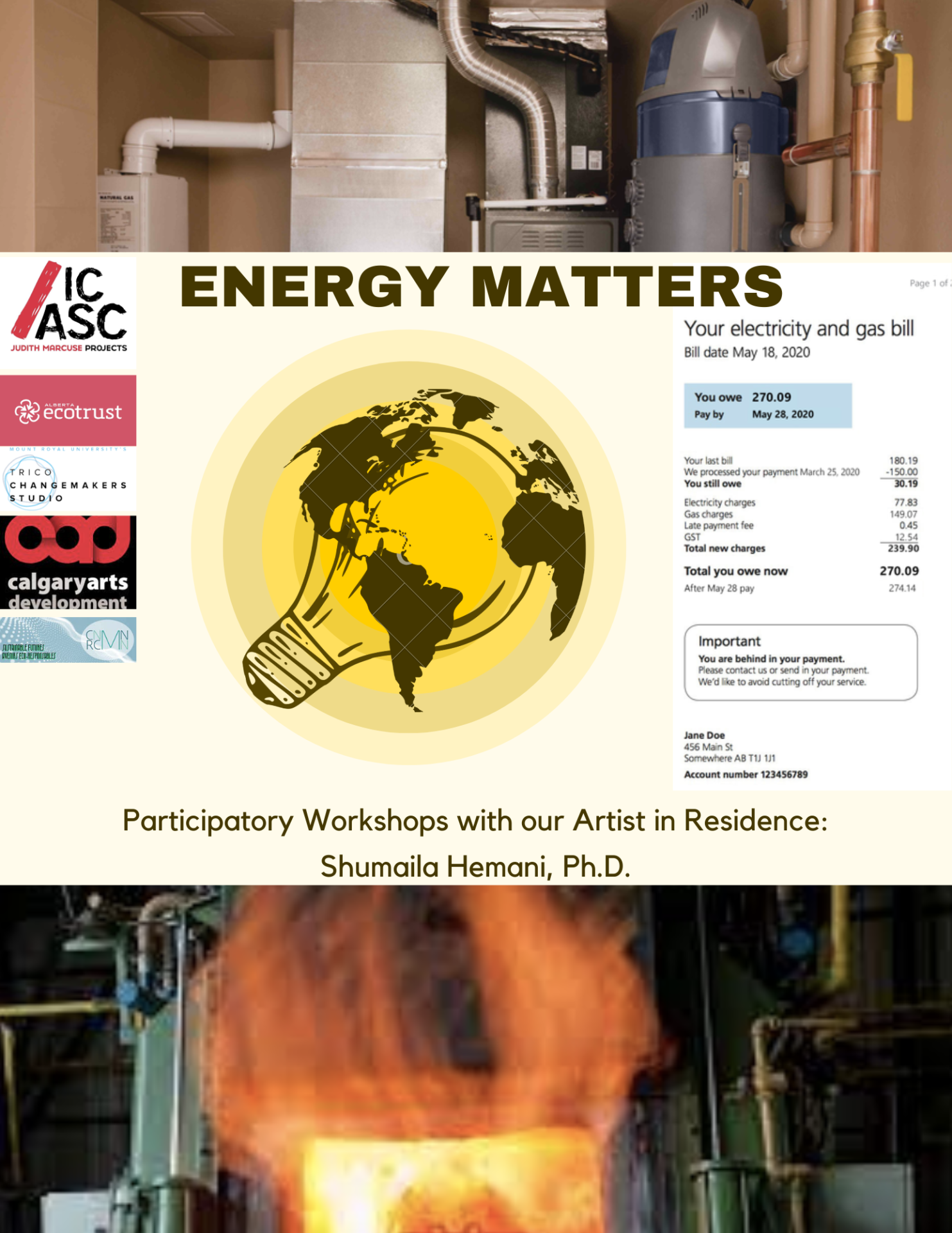
As part of my artist residency at FUTURES/Forward, the International Center of Arts for Social Change (ICASC) funded by the Canada Council for the Arts and the Metcalf Foundation and Trico Changemakers Studio at Mount Royal University funded by the Calgary Arts Development, I partnered with Alberta Ecotrust to apply my artistic practice of deep listening and soundscape composition to initiate arts-inspired dialogue on energy affordability.
Energy is an increasing concern for many Canadians; however, speaking about (un)affordability continues to hold the stigma amongst people who are experiencing difficulties paying the energy bills on the one hand and on the other hand the issue is not prioritized by new regulations for clean electricity and Canada’s prompt transition to net zero. In the series of community-engaged arts workshops, Energy Matters, we involved stakeholders to address questions such as: How vital is energy affordability in developing #sustainable #cities? How do climate change and Canada’s transition to NetZero impact low-income groups struggling with energy affordability? Why must affordable housing integrate energy affordability?
The activities outlined in this portal would be helpful to any environmental organization holding a similar kind of arts-inspired dialogue on the climate crisis, energy justice, and climate justice. The guided meditation attached to this project would help practitioners in creating a safe and inclusive space where participants could discuss their work on energy poverty.
1) Begin each workshop by creating a safe space that brings together the community’s understanding of what “safe space” means and how it would be nurtured.
2) Welcome community members into the space and practice an activity for grounding and centring that helps individuals to overcome their resistance and nurtures more openness. This can be done with a meditation that brings attention to the breath and to the sensory stimuli around or with a walking meditation.
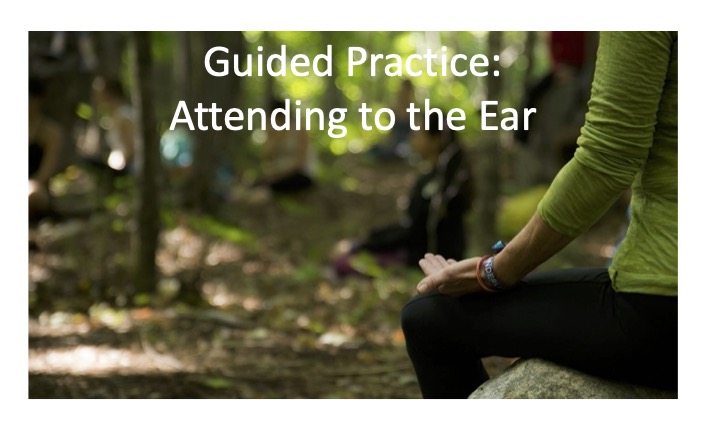
Here is an example of a guided practice and the attached score and video is an example of how it is conducted in a workshop setting. See the score below for a downloadable version. You can find audio examples of similar guided meditation practices for workshops in the guided meditation links below.
Walking Meditation for Grounding and Listening to the Earth’s Pulse
Stand with feet about shoulder-width apart. Shoulders relaxed, soles of the feet connected to the earth, knees a little soft, palms at the sides. Eyes are in soft focus, seeing everything.
[POSTURE] *
Adopt a natural stance. Bring your attention to the soles of the feet. Imagine that you are growing roots down into the earth. Let the roots be your anchoring to the earth.
Since the soles of the feet let the energy of the body sink into the soles and roots. The knees are a little soft to promote circulation.
Shoulders are relaxed. Palms of the hands relaxed.
[VISUALIZE]*
Visit your heart and allow a very pleasant memory to emerge.
Visualize and light up your spine travelling from the tip of the tailbone, vertebra by
vertebra up into the skull.
Imagine a golden thread shooting out of the crown of your head to a distant star.
Imagine that the upper part of your body is floating suspended from a star. Try to
balance the feeling of the lower body rooted to the earth and the relaxed floating
sensation of the upper body.
The chin is tucked under a bit to help align the spine.
Try to bring your body into this alignment at different times of the day whether you are
sitting, standing or walking.
[AFFIRMATION]*
Now repeat this affirmation: With each step, I feel the earth holding me, supporting me, sustaining me. I am simultaneously slowing each breath.”
Thank you for joining me in this guided practice.
*The words and phrases in square brackets need not be said aloud. It is to help the guided practitioner to pause as the meditation transitions from one phase into another.
After this guided meditation, the participants can be engaged in questions for reflections on the jam board followed by activities that engage them in an artistic activity and a dialogue pertaining to energy accessibility. For more details, please refer to part b) and part c) of this project.
Art can become a means to integrate marginalized voices into the conversation. It can voice aspects of the issue not otherwise expressed in public documents or policy statements. Art helps us to listen better. How might we harness the power of arts to explore issues around energy accessibility? Energy affordability is an increasing concern for many Canadians; however, speaking about (un)affordability continues to be problematic. In the series of community-engaged arts workshops, Energy Matters, we involved stakeholders to address questions such as: How vital is energy affordability in developing sustainable cities? How do climate change and Canada’s transition to Net Zero impact low-income groups struggling with energy affordability? Why must Affordable Housing integrate energy affordability?
I was privileged to collaborate (as the FUTURES/forward and Trico Changemakers Studio’s artist-in-residence in co-creating and facilitating the Energy Matters project) with Alberta Ecotrust (SEE the LINKS BELOW for more information) and their partners (ACORN, Kambo, Energy Efficiency, All One Sky, and others) in their Energy Poverty and Home Upgrades Program. Energy Matters was a series of participatory arts workshops where participants (stakeholders who were energy advocates within their organizations, including Home Upgrades program staff at Alberta Ecotrust and advocates from Ecotrust’s partners: ACORN, All One Sky, and Calgary Alliance for the Common Good) engaged in arts-based dialogue around energy poverty using creative activities to reflect on the ways energy affordability is connected with climate change and the pro-poor policies that could generate more equity. The project was based on intersectional ethics of care that looked at the ways energy affordability impacts various sections of our society, including seniors, people with disabilities, women, and newcomers.
Each workshop started with an activity that involved embodied deep listening and attuning the ear to approach questions about energy unaffordability from an auditory approach that facilitates creating sound arts for social change. Refer to Part A in PCM hub to see an example of this activity. Part B will assist you in creating prompts for participants to reflect on.
1) Following a guided meditation, involve the participants in an auditory reflection activity that pertains to their everyday realities and their experience of them. See below for examples:
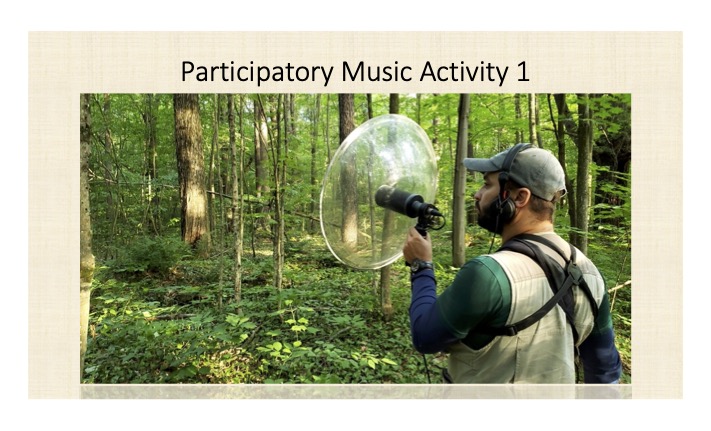
Example 1: What is the one sound that you heard this morning that brought you here today. [See the attached video]
Example 2: What are the sounds that you find agreeable and calming?
Example 3: What are the sounds that you find unpleasant and disrupting your comfort?
2) Next, engage the participants in a reflection that pertains to their work on energy accessibility.
See the images below as an example of how the participants were involved in a critically self-reflexive dialogue that ensured the creation of a space of openness and mutual respect where they shared the biases and prejudices that they bring to their work on energy accessibility. Participants were asked to question the biases and prejudices they bring to their work addressing energy inaccessibility. What are the limitations to their listening to people experiencing the crisis of energy affordability? [See the responses of one group in the jam board in the image gallery below]
3) Ask participants to read other responses on the jam board and share their perspectives. [See the attached video for an example of this activity].
The Energy Matters workshop series was located at the intersections of interdisciplinary and participatory sound art for climate action and justice, involving stories, sounds, word bubbles, gestures, and movement. In these workshops, we co-created deep listening experiences and new soundscape compositions based on artistic activities facilitated by Shumaila Hemani. The content of these workshops will be adapted to tailor participants’ needs, interests, and assets.
We aimed at creating a safe and inclusive space where participants can discuss their work on energy poverty, what brought them to this work, and how it has impacted the ways they understand and engage with the concept of home or dwelling. It will give them a space to share how their subjectivity (age, race, gender, disabilities, etc.) influences how they approach energy poverty.
We investigated the present understanding of this subject within Alberta and Canada, and what kinds of challenges or stigmas people confront in accessing support to ensure energy affordability. To ensure equity, inclusion, and fairness, we engaged the participants in a critically self-reflexive dialogue that ensures creating a space of openness and mutual respect. One such practice could be gathering participants’ precepts around poverty and energy consumption, energy transitions, and energy poverty through a variety of creative activities.
There are many benefits of deeply listening to the world as it cultivates empathy, trust, inclusion, compassion, and more.
1) Initiate a dialogue on energy accessibility by asking the participants to listen to their domestic settings and how different sounds in their spaces make them feel.
Example of a Prompt: How do you listen to the sources of energy and energy consumption around you such as the burning of fossil fuels through furnaces, engines, and more? Can you list the sounds of energy consumption in your domestic settings and how you relate to those sounds? [See the image below for how participants responded on the jam board] [Listen to the attached audio to see how participants described the sounds in their domestic settings]
2) Ask the participants to make any sound recordings of the energy end uses in their domestic settings. Allot 5 minutes for this activity
3) Ask the participants to share any sound recordings of the energy end uses in their domestic settings and why did they choose this sound, how do they relate to this sound, and whether are there any memories that this sound brings to their mind? [Listen to the attached audio for an iteration of this activity]
4) Next, engage the participants in a dialogue about their journeys and work on energy accessibility. [See the attached video of participants talking about how they came to this work.
Example of a prompt: How do you relate to the question of energy inaccessibility in your life? Reflect on defining moments that inspired you to become advocates, leaders, changemakers, and artists addressing energy poverty. (Watch the video below for an iteration of this activity.)
The soundscape composer, Hildegaard Westerkamp writes, “True receptive listening comes from an inner place of non-threat, support and safety. Paradoxically, while a grounded and calm state of mind, a sense of safety, peace and relaxation are essential for inspiring perceptual wakefulness and a willingness and desire to open our ears, normal routines, habits and patterns will be disrupted and laid bare in such a process of listening; noises and discomforts inevitably will be noticed, and all kinds of experiences will be stirred and uncovered. Listening in fact implies a preparedness to meet the unpredictable. and unplanned, to welcome the unwelcome. As such, listening is inherently disruptive as it puts a wrench into the habitual flows of time, and habitual behaviour of daily life. ” (THE DISRUPTIVE NATURE OF LISTENING: TODAY, YESTERDAY, TOMORROW, p.45)
Is there a singular experience of energy poverty? The experts describe energy poverty as an elephant in the room being explored by people who understand energy poverty from their own positionality. Yet, despite the ambiguity of this term, there continues to be a high degree of stigma around discussing energy inaccessibility in public debates. What is usually mentioned in the reports is important but equally so is that which is left unsaid or does not find its way into the mainstream conversation. In these arts-based activities, we will re-discover those places of vulnerability that make us look at energy poverty through a compassionate lens.
1) Distribute a recent report on energy inaccessibility or a relevant topic and ask the participants to reflect on it in advance. Example: Clean Electricity report by Canadian Climate Institute published in June 2023 (please see score section for report).
2) Involve participants in a dialogue about the report. Use the following prompts as an example:
Prompt 1: What do folks think about this report?
Prompt 2: Has this report missed anything?
Prompt 3: Are the statistics to be accepted as facts or is there something that the report is not saying?
3) Depending on the comfort level of participants, go deeper and take a more analytical and critical stance by asking a direct question where their expertise will be prompted.
Example 1: The report says that clean electricity is cheaper. Do you agree/disagree and why?
Example 2: Are there any other ideas that are coming to your mind?
[Watch the video example as an iteration of this activity]
This sonic meditation allows participants to improvise vocally while exploring an outdoor space with others. It is an opportunity to walk while singing, observing the constantly changing sounds of other singers and phones. It is also an opportunity to listen to the effects of physical space on certain sounds as well as the evolving responses of other singers. It invites focal listening (to one’s own cellphone) as well as global listening (to the other voices, other cellphones and surrounding sounds.
The cellphone, using a free app (echoes.xyz) plays a series of GPS triggered sounds as participants walk through each zone. Instructions are given (sonically) at the beginning of the walk, inviting singers to either sing in unison or on any other note anytime in response to the sonic prompts they receive from their phone. The prompts are easily programmable on the Echoes app.
In one case, the words ‘here’ and ‘now’ were sung on extended tones and played in different zones around a park area. Gradually participants began to explore interacting with each other. See video below.
It is social singing while being outdoors, ideally in a public space giving everyone equal footing on the area. (GPS is not as effective indoors).
ACTIVITY BREAKDOWN
Where: Any outdoor area with any particular interest, geographically, socially, logistically
Duration: 20 minutes would be a minimum
Participants/Target Audience: Anyone who loves group singing and listening.
Group Size: Any size is possible. The greater the number, the more vocal and cellphone prompts, enriching the sonic possibilities.
INSTRUCTIONS
Find a site that you would like to explore vocally with others, one that you enjoy being in. Use the app https://echoes.xyz/ to create your own walk by creating ‘zones’ of any size filled with any sound you like, on a loop or just once. Invite participants to download the free app which plays your walk when entering the designated zones. One can stay in any zone for any length of time.
Participants sing along in unison or any other note anytime in each zone. Other sonic meditations can be created from different kinds of sonic prompts to elicit different kinds of vocal responses.
“The challenge of composing loops, their tonalities and rhythms, was inspiring for me. To hear staccato orchestral hits, on my device and then milliseconds later on another’s tickled me. To hear harmonies and dissonances dance at their own whim also was endearing. ” Josh Fourney, participant.
The Newcomer Youth Engagement project connects music and literacy while also connecting our university and a community organization that supports educational initiatives for newcomers to Canada.
Who we are: Our music team at the University of Saskatchewan partnered with the Saskatoon Industry Education Council and Newcomer Youth Engagement Program which is funded by Immigration, Refugees and Citizenship Canada. There are approximately 18 students in each of the two classes, and they range from 17–21 years of age.
Our goals: Together, our team has developed original curricula and we engage the students each week in musical activities of singing and playing instruments that connect to themes of their language studies to develop language skills in written and oral communication.
An important goal of the collaboration is to “Celebrate that everyone’s music is Canadian music and contributes to the fabric of Canada’s culture” and that this learning experience will facilitate the sharing of the students’ cultures and support the youths’ sense of belonging and connection to their own culture and the new country to which they are integrating.
Songs of Success:
1) The music we use in our iterative curriculum design invites the music from the students’ countries of origin and we also use some tried and tested early years songs in English that teach vocabulary and develop their literacy skills.
2) We have incorporated Popular Music songs throughout the program. As the students’ language skills developed and we had developed a relationship of trust where they felt valued through their music, we explored concepts of rhythm and beat through contemporary songs that they shared from their countries of origin. We also incorporated some more contemporary English songs into the language studies and the students responded very favourably to learning the words, themes, messages and meanings of the songs we introduced.
Complementing Activities: Since many of the students would have heard the songs, we could focus on written literacy skills through reading and writing the words.
We incorporated various activities with the lyrics including post-it note activities in which students had to unscramble the phrases in the song or song titles to put them in order, or find the incorrect words (often rhyming words) on the board and correct them with the proper word found in the song.
At the end of the year, we compiled a playlist of the songs we have learned and sung that showcased the students’ artwork from their art class that highlighted the theme of each song.
Lesson Structure: A lesson is one hour and follows a typical lesson structure as follows:
Welcome song
Call & response rhythms & melodies
Learning new songs – (Graphics on screen, hand gestures – to indicate opposites, contractions, literal/figurative, etc. — and tactile & kinesthetic activities — post-it note games, assemble a snowman on the board, stand up when your birthday is sung in the “Months of the Year” song, raise hand when we sing an adjective, etc. are all essential as we learn new song lyrics.)
Playing percussion instruments (listen & play-back exercises, playing along to a song, finding the beat of a song, and using instruments to help create word-based rhythms)
A review of today’s learning
Goodbye song
Project Outcomes:
Increased social bonding/cohesion
Increased language comprehension, facility, and fluency which can even be marked by observations of students using language for humour
Ease of communication through singing
Rich opportunities to explore new words, grammar concepts, colloquialisms, connections, and ideas provided through examination of song lyrics
The sense of pride & belonging students demonstrate when their favourite music and places from their home countries are part of class activities.
Increased agency in their decision-making and input for artistic choices
Designed and implemented in Plaisance by Frédérique Drolet and Mariane Lacroix (2022)
1. Context
The birdsong course was designed by Frédérique Drolet (soprano) and Mariane Lacroix (naturalist from Parc national de Plaisance) in 2022. The activity was created specifically for the Grand défi ornithologique des parcs nationaux, organized on June 11, 2022 by the Sépaq network, the magazine QuébecOiseaux and the bird watching clubs of several regions of southern Quebec. It has been developed for an intergenerational family audience, suitable for birdwatching enthusiasts or neophytes.
This workshop was designed to combine :
The educational mission of the Park regarding the conservation and protection of biodiversity
A creative artistic approach through the exploration of the voice
The goal is to make art in nature and to sharpen our sense of observation of nature, thus opening us to the infinite source of inspiration that it offers us.
2. Educational objectives
To discover a number of bird species in Quebec (in particular the breeding birds of Parc national de Plaisance)
To learn specific information about these birds with the help of :
photos
scientific data
sound recordings
warm-ups and playful vocal exercises inspired by their songs, their approaches, their characteristics
Learn to recognize bird songs using the human voice
Explore the different sounds of our voice
Discover our creative potential
Introduction to certain musical and theatrical concepts such as rhythm, pitch, timbre, nuances, physicality, etc.
Collaboration and socialization through intergenerational teamwork
3. General course of the workshop (90 minutes)
Welcome and presentation of the activity to the participants
Icebreaker game in a circle to get to know each other and establish the group dynamic
Vocal, body and rhythmic warm-up activities inspired by birds
Discovery of the breeding birds of the Parc national de Plaisance (between 3 and 5)
Activity of creating imaginary bird songs
Conclusion
4. Warm-up activities
Most of the warm-ups are inspired by birds from here and elsewhere, whether by their song, their call, their gait, their physical characteristics or certain characteristics of their habitat or behaviour.
To elaborate these warm-ups, we can be inspired by the observation of birds in our environment, but also by videos, recordings (the Merlin Birds application is a real treasure!), books and photos. Here are some examples:
Stretching and mobility exercises: wriggling, moving only your eyes like a pigeon, spreading your wings
Rhythm exercises (walking/body percussion): with fun sounds, such as moving in a hoop doing the “chicken cha-cha” (123-pock-pock-pock) or doing a courtship with coloured scarves
Breathing exercises (low/rhythmic breathing with walking): raptor glide (exhale on tsss… as long as possible while extending arms)
Bird inspired vocal warm-ups:
Wild turkey (ah! Gobble-gobble!)
American Bittern (woodblock, water sound, tongue click, imitate cattail in the wind)
Singing sparrow (brrr…)
5. Discovering nesting birds
This section was developed jointly with Mariane Lacroix, naturalist of the Parc national de Plaisance, with the goal of introducing participants to some of the breeding birds of the Park or the surrounding area, which they could then identify during their future walks.
The selection of the few birds was made by Frédérique, from a long list provided by Mariane. To reproduce bird songs with the voice (and not by whistling) requires many hours of listening to the songs (on the Merlin Birds application, for example), of vocal exploration and… imagination! The goal is not to perfectly reproduce the bird’s song or call, but to make sure that the participants will be able to recognize the bird’s song in nature after having practiced it while having fun. For this reason, the birds to be presented in this section must be carefully selected.
Procedure for each of the birds chosen:
Singing quiz: the artist-mediator does a free imitation of the bird in question, without revealing its name to the participants. The participants try to guess the name of the bird in question.
Presentation of the bird (name, habitat, biological characteristics, photo, etc.) by the naturalist
Listening to the bird’s song/cries on the Merlin Birds application
Vocal exercises and fun games inspired by the bird, sound specificities: briefly discuss certain musical concepts such as timbre, pitch, rhythm
Learning the bird’s song (voice and staging): break down the different parts and create a fun little choreography!
6. Imaginary Bird Activity
Following the previous discovery activity, which contains both information about existing birds and their natural habitat, and musical exercises, participants are now invited to create their own imaginary bird song.
Procedure:
Form teams of 2 or more people
Explain the process
Give the instructions to be respected:
The song must be repeatable
The song must be short
The song must be teachable to the other participants
You must find a name for your bird
Give an example with certain parameters chosen at random or given by the participants
Invite teams to pick up colored scarves during their preparation, if they wish
Distribution of parameters to teams
The parameters written on paper are prepared either by the mediator in advance, or by the participants themselves during the workshop (this can be a preparatory activity for the creation of imaginary bird songs, see point #7 below).
Teams can therefore receive a “coconut” with parameters already defined inside, or they can draw the parameters from containers. If there are 3 different parameters, 3 containers will be prepared and the teams will be asked to draw one or more papers from each container, depending on the established parameters.
The teams have 7–10 minutes to create their bird song. If they wish, they can also find a particular physical expression for it (walk, posture, etc.)
Invite teams to present their bird (the entire team can present, or designate one member to present solo)
If time permits, one designated member per team will teach the imaginary bird song to the entire group.
7. Setting parameters and possible preparatory activity
It is essential to provide parameters for inspiration for the creation of the bird songs, especially if the workshop is for participants who have no musical experience. If time permits, I suggest doing a preparatory activity with them to create these parameters, which can then be mixed and picked up. If not, we can provide parameters on chart paper or “coconuts” with some parameters inside.
Setting parameters with participants:
In a brainstorming session, invite participants to propose the parameters that will be used to create the bird songs. Anything goes, since these are imaginary birds! Here are some suggested parameters with examples to inspire participants:
What might the imaginary bird’s song sound like?
A leaky faucet
Someone gargling
The sound of high heels clicking
Wind rustling through the leaves
A car that has trouble starting
Which family would be the bird’s cousin?
Chicken
Parrot
Owl
Eagle
Peacock
In which habitat could the bird live?
In the sand
On the planet Mars
On the roof of a cathedral
On the water lilies
In what situation is the bird?
It is taking his bath
It meets a rival
It is looking for a mate
It is about to incubate its egg
What onomatopoeia could be found in the bird’s song?
Hi-ha-haaaa
Gulp! Gla!
Tsîîîîk-tsi
Yong-yong-yong
Etc.
Establishing a joyful and welcoming group dynamic is essential for the activity to run smoothly. Participants should feel that this is a group exploration session, not a technical singing class.
Encourage participants by example to come up with ideas, to laugh at themselves, to be silly… don’t take yourself too seriously and put your ego aside!
Ideally, the activity takes place in nature, in a place where the group is not observed by people who are not participating in the activity. This avoids the embarrassment that some participants might have and allows them to dive into the proposed activities in a more natural way.
For more information or for any questions, please contact
This framework for online group music lessons provides a collaborative experience of developing musicality through creativity, while still encouraging each student to work independently towards their own personal music goals.
The Framework
Each session cycles through the Kaleidoscope Music framework:
Connecting & Preparing
Exploring & Skill Building
Creating & Collaborating
Quests & Questions
Sharing & Reflection
See scores below for example activities for each part of the framework.
Length of time spent in each part of the lesson depends on focus of the group in the scope of the year plan (such as preparing for sharing), and the students’ individual needs and interests. The framework is designed to adapt and use ongoing feedback from participants to co-create with the teacher, while using the expertise of the teacher to facilitate effective activities and exploration.
Quests & Questions is the time when students work individually on their own projects, goals, and explorations. Examples of this include:
learning a song they have chosen using sheet music or chord charts
working through the activities in a method book (ie. Piano Adventures)
working on a songwriting project, recording improvising activities, etc.
preparing a song for a performance
We use the private audio channel feature in Muzie to allow for individual feedback and discussion between each student and the teacher. The teacher cycles between students during this part of the class, keeping an eye on the video feed and chat for which students need assistance. Students should use this time to proactively work on their Quests, rather than waiting for the teacher to tell them exactly how to proceed. This time is intended to develop student initiative and independence, which can take time and coaching to cultivate. It’s important to regard student exploration as valuable rather than seeing it as off-track or unfocused. For example, a student that is improvising rather than practicing a particular goal (like a song they had chosen) isn’t necessarily distracted. If they are self-selecting to explore ideas and techniques, integrate skills, and create new music, it may be that they are quite focused indeed!
Students are encouraged to work on their Quest in between group sessions, and to send questions via Muzie chat, Muzie clip recordings (short videos), or email if they feel “stuck” in between lessons. The teacher can record or upload duet and backing track parts within Muzie’s audio recorder, and the student can also make layered recordings with teacher accompaniment (this can be done during groups or outside of group time).
When the group comes back together to share, students have already discussed with the teacher during their 1:1 time what they would like to share, if anything. Sometimes students perform just for applause and sometimes feedback and reflection activities happen during this time. Students can also share about their process and discuss strategies, goals, etc.
Selecting activities for each section
How do we decide how to spend our time in each class? The facilitator can plan and suggest activities for the group and also stay flexible. See attached scores for activity examples.
encourage the participants to co-create and contribute ideas for activities
listen and encourage participants to share thoughts about what would serve their learning and creative journey
plan times to to ask the participants discussion prompts or just to to check in (a good opportunity to see what they had on their minds and learn from their perspective, which can also help other students)
ask participants to help identify the next steps (so that they can practice self advocating and planning creativity and learning)
invite participants to share musical or inspiration brought from their lives
discuss musical questions as a group and ask what the students are wondering about in an open-ended way
invite participants to share music they have been playing or just enjoying, and try using those songs for other activities
repeat activities for several weeks, return to them intermittently, or evolve and iterate the activity to explore ideas or continue to develop skills or techniques
The categories of activity can change over time- for example, what starts out as a creating and collaborating activity that appears mid-class after a warm-up, may become more of a warm-up activity if the participants are already familiar with the activity. They may want to pick up where they left off from an activity in a future class, or create their own “quick start” simplified versions of an activity.
As the repertoire of songs and activities develops, and as the participants gain musical skills and learn to collaborate, new possibilities to extend songs and activities emerge. What started off as just a simple song can become a long series of activities as the kids explore, adapt, remix, and however else they discover to creatively make music. Some of this can be suggested by the teacher but often the participants have a lot to share from their already rich creative experiences, innate musical abilities, and intuitive wisdom about their musical journey.
Background and Context
Lauren Best taught private music lessons for more than a decade in Toronto, Owen Sound, and online. She experienced the power of group participatory music and an emphasis on participant creativity while facilitating music programs as well as across multiple art forms including interactive theatre and digital media arts. She wanted to keep the best of what worked well teaching private lessons, but add the benefits of group music making, collaboration, and sharing in a peer group. By offering lessons in groups, it also allows for more opportunities for scholarships through sliding scale or waived tuition.
In 2021 Lauren launched online group music lessons for ages 6+ with an emphasis on collaborative creativity, and in 2022 the groups were rebranded as Kaleidoscope Music. Groups were comprised of students who were mostly located rurally or in small towns.
In year 1 (2021–2022) the program began with piano and ukulele group classes in same-instrument groups meeting weekly for 1 hour. In year 2, (2022–2023) classes were changed to be mixed-instrument (piano, voice, and ukulele in the same class, with student welcome to combine or switch instruments over time) and 50 minutes in length. In year 2, the groups were also offered for adults but there was insufficient enrolment to create a test group with adult participants.
See attached PDF titled “Tech Considerations” for further technical considerations and options for the teacher/facilitator.
What Kaleidoscope Music parents say:
“I love that my children have something that they can work at, puzzle out, play with, and progress on. I can see how their pride and self-confidence have grown this year.”
“The best part about my child learning music is seeing their interest and passion grow deep and wide.”
“It is beautiful to watch your child learn and master a new skill, and to witness them persevere and grow.”
“What I value most about [my child’s] music lessons is learning a new musical language with which to express yourself.”
Singers in this collaborative choral music creation project explored how sounds gathered from their everyday lives could speak to aspects of place, identity, and community in new vocal soundscape compositions they created, graphically notated, and presented with participation from the entire choir. “Exploring Sonic Lifeworlds” took place between February-April 2023 with the University of Toronto Scarborough (UTSC) Concert Choir, director Patrick Murray, and facilitator jashen edwards.
This project was divided into three parts, which serve as standalone activities and as a sequence that builds skills and understanding around collaborative composition and collective meaning making in sound. Below, we narrate the process of each of these activities, provide extra resources, and offer student reflections on the project. A workbook with expanded descriptions and resources is available to download.
Part 1: Sound Session Workshop with jashen edwards
Prior to the workshop, singers are asked to gather meaningful sounds from their everyday encounters by recording and uploading chosen sounds to an online class archive using the Padlet app (click to see example, or see links in workbook). During the two-hour workshop, edwards leads singers through a discussion of how these sounds impact their everyday understanding about themselves in relation to the world. Using the sound collection and classification (SCC) table resource, singers explore the musical potential present in everyday sounds and improvise short musical pieces by re-creating these sounds vocally and/or physically. Singers gain specific ways of listening and working with sound that provide the needed tools to compose original pieces in Part 2 of the project.
Participant Reflection: “This fascinating lesson broadened my horizons about experimental music-making…Before this session, I had never imagined that all these auditory sounds could be imitated by the human voice, and when combined they could be so harmonious and pleasing to the ear.”
An expanded description of the Sound Session Workshop, including the SCC table resource and the UTSC Concert Choir class Padlet, is included in the attached workbook file. Listen to the attached audio for an example of workshop outcomes.
Part 2: Soundscape Composition Activity
During the month following the workshop, singers organize into small groups to create short (1–2 minute) vocal soundscape compositions about a topic/theme of their choice that they will lead the entire choir in performing. While “soundscape” is our chosen term for these co-created compositions, singers interpret this broadly; some groups create participatory songs incorporating melody and rhythm as well as environmental sound, while others create more “traditional” sound pieces.
Each group’s soundscape must clearly be “about” something that speaks to their group members, and involve sounds from the Sound Session workshop. Groups come up with widely varying topics/themes, including climate justice, Lunar New Year, A Night at the Movies, anti-war protest, and end-of-term fatigue. Singers are given prompts to consider how they might structure, sequence, and combine sounds to form a composition that speaks to their theme. Finally, groups must involve the entire choir in performing the piece. On the last day of class, each group leads the choir through a demonstration/teaching and then “informance” of their soundscape composition together.
Participant Reflection: “[This project] gave us the opportunity to learn how to create music that is easily taught and inclusive to the community. It allowed us to recognize the importance of considering what is inclusive to anyone with any musical experience.”
The attached workbook provides materials to guide soundscape creation, as well as rubrics for assessing the project as a curricular assignment. See also the video below for highlights from student soundscape presentations.
Part 3: Graphic Scoring Activity
In a final activity, each singer creates a “score” for their group’s soundscape that could serve as a teaching aid or guide for someone else to follow or reproduce their piece. Singers are allowed to use any combination of text, graphics, or varying forms of musical notation to represent their soundscape, and are provided with a template (see workbook) to help represent certain musical elements, including duration/timing and layering of sound. The score need not represent all aspects of the composition, but should creatively reflect their creation. As many members of the UTSC Concert Choir join with varying experience reading Western musical notation, this activity proves particularly valuable in reducing barriers to participation and opening up perspectives on what constitutes musical “literacy;” some singers choose to incorporate other forms of musical “notation” into their scores that they feel more comfortable with, including solfege, digital audio data, and jiǎnpǔ (number notation). See Scores below for examples of student creations.
Participant Reflection: “I learned that we should not be limited by the traditional way of learning music by looking at traditional scores and notes. There are many different ways that music can be represented. I tried to apply this concept of not using traditional music notation to my music score in the co-creation project. This mindset of thinking out of the box is the most unforgettable thing I have learned from this course.”
Conclusion
The Exploring Sonic Lifeworlds project focused on several needs of our own musical community at UTSC, as well as creating resources for other choirs and singing groups to use to:
Make space for singers to express their own musical and cultural backgrounds and social justice issues significant to their lived experiences through sound.
Value musical creation alongside re-creation in choral curricula and programming.
Practice transferable skills including teamwork, public speaking, and group facilitation relevant to music-making in community spaces.
Value alternative expressions of musical literacy through creative visual notation.
Build relationships between singers through collaborative musical creation.
Participant Reflection: “Overall, our co-creation process was a collaborative and enjoyable experience. By incorporating elements from our individual soundworlds, we were able to create a piece of music that was meaningful to all of us.”
About the Leaders/Participants
Recent PhD graduate, jashen edwards’ research explores ways everyday sounds can be a catalyst for creative critical engagement. Intersecting scholarship and practice across the fields of music, music education, sound studies and sensuous scholarship, jashen designs and facilitates sound session workshops for a variety of educational settings (e.g. PK16, carceral, senior homes, community centres).
Choral conductor/composer Patrick Murray directs the University of Toronto Scarborough Concert Choir, and serves as Artistic Director of Chor Amica (London ON), Director of Music at St. John’s Elora, and Associate Conductor with the Bach Children’s Chorus. His research explores the practice and aesthetics of community collaboration in contemporary choral music.
Unique amongst campus ensembles, the University of Toronto Scarborough Concert Choir serves as both a curricular and an open-access (non-auditioned) community choir, welcoming approximately 100 singers each term from programs across the campus and serving as a credit course for students in the Music and Culture concentration.
Sounds of Home is a collaborative songwriting initiative for refugee and newcomer youth. Over the course of 6 weeks, participants explore the theme of “home” through group music making and songwriting. The three main goals of the project are to:
Build relationships with and among the youth in order to increase their sense of belonging in their new community.
Increase a sense of empowerment and agency amongst participants through the skill of songwriting.
Allow participants to develop a stronger sense of identity through guided self-reflection.
This project is run in collaboration with Heffner Studio, an audio digital production lab by Kitchener Public Library, and a community-based organization that offers resettlement services and support to refugees and newcomers in the Kitchener-Waterloo Region. There is also the possibility for the program to be delivered virtually using Zoom for another video conferencing platform.
Each session includes an icebreaker activity, group music making, and songwriting exercises. Since participants may not speak English as their first language, they are free to write in whatever language they choose.
Process:
Week 1: Each person in the group will have the chance to share their name, pronouns, and their favourite song. We’ll listen to the song as a group, and then the sharer will have a chance to talk about why they like it and what the song means to them. These songs are then added to a playlist which is shared with the group. This is a great first icebreaker activity because it gives participants a chance to share something about themselves without requiring them to step too far out of their comfort zones. It also acts as a great jumping off point to talk about qualities that make a good song (i.e., a catchy hook) and to talk about song structure. For example, participants may be asked to identify what the chorus of the song was.
As a group, we’ll create a mind map of things that remind us of home. Participants are encouraged to incorporate their senses and think of places, foods, smells, feelings/emotions, etc. It’s important to note that contributions may not be happy. For example, participants may mention missing home or other complicated circumstances. It’s important to hold space for all of those realities.
Once the mind map is finished, we’ll review what was written and pull out key themes. If meeting in person, this activity works well with a white board and/or sticky notes. If meeting virtually, you can use Jamboard or a similar mind mapping program.
Participants are asked to record at least one sound that reminds them of home and to bring the recording with them to the next session. These will then be incorporated into the final recording of the song.
Week 2: At the start of the session, each participant will have the chance to share their recording(s) and talk about why it reminds them of home. We will review the mind map and key themes from Week 1, then the group will work together to write a 4‑line chorus. This session will also include a short discussion on the importance of rhyme. When the lyrics are finished, the facilitator will ask the group what they feel the emotion or mood of the song is, and then improvise a few different chord progressions and melodies and ask the group to choose which one they like best. Depending on the comfort level and musical experience of the group, participants may also want to contribute chord progressions and melody suggestions. Before the end of the session, a recording of the chorus will be made and shared with the participants so that they can listen to it throughout the week.
Week 3: To start the session, the facilitator will play the chorus and participants will have the chance to suggest changes. Using the prompt, “home is…” participants will work on their own or with a partner to write a 4‑line verse for the song. They will be encouraged to think about their own unique perspective(s) and can draw on themes or ideas from the mind map from Week 1. The facilitator will check in with individuals/groups to offer feedback and guidance. At the end of the session, participants will be encouraged to share what they wrote with the rest of the group.
Week 4: During this session, the facilitator meets with each individual or pair to edit their verse and set it to music. Some of the verses may also be used as a bridge section. During this time, the other participants can continue to work on their verses or on another activity. Once the verses have been finalized, the facilitator will make and share a recording of the song so that participants can listen to it during the week.
Week 5: This session is focused on getting the song ready to record. The facilitator will perform the whole song for the group and participants will have another chance to give feedback or suggest changes. For the rest of the session, we will continue to review the song as a group and finalize the arrangement including what instruments will be used, who will sing what part, etc.
Week 6: In the final session, participants will use the recording studios in Heffner Studio to record their song. The facilitator should record all of their parts before the session in order to maximize the amount of time the participants are recording. Participants will take turns recording their verses or playing instruments. Following the session, the facilitator will mix the song and then send the final version to the participants.
From a participant: “Because of this workshop I got to meet new people and make music, which was something I had never done before. I’m very proud of the song we made together!”
As part of the Education Sector Focus, public school music teacher Doug Friesen shares a few improvisation games his students love to play.
GAME 1: Four!!
After a cue, each participant tries to make short sounds, one at a time, when no one else is playing or singing.
Every time you make a sound, when no one else is, you get a point.
Whenever you make a sound at the same time as someone else you must start back at zero.
Once you have collected four points you yell “FOUR!!” and the piece is over.
Ears wide open!!
See 2:12 in the video below for instructions given by Doug, followed by an example of his students playing the game.
GAME 2: Empty Repeating Canvas
Put two empty 4/4 measures (or just the numbers 1 through 8) with a repeat sign up on the board.
Each persons picks a sound and a moment in these 8 counts to make it.
Repeat your sound in the same spot each time.
Count it in and let the groove settle.
Variations
- Add a hand signal that cues a change of sound and/or placement.
— Add changing dynamics.
— Make sounds “more musical” by deciding on a chord or a scale to choose from.
— Extend the number of measures.
— Change the time signature.
— Try adding long notes for part of the group or every other time through. - Make sounds less musical by adding a soundscape theme.
— Decide together on a nice opening and closing section.
This is heavily inspired by a workshop with Fred Frith in which he introduced my students and I to a composition of his called Screen. It was a photograph with two empty bars of 5/4 sketched on top.
For more games such as these, see the Education Sector Focus co-directed by Doug Friesen and Louise Campbell.
Lorem Ipsum is simply dummy text of the printing and typesetting industry. Lorem Ipsum has been the industrys standard dummy text ever since the 1500s, when an unknown printer took a galley of type and scrambled it to make a type specimen book. It has survived not only five centuries, but also the leap into electronic typesetting, remaining essentially unchanged.
Step 2
Lorem Ipsum is simply dummy text of the printing and typesetting industry. Lorem Ipsum has been the industrys standard dummy text ever since the 1500s, when an unknown printer took a galley of type and scrambled it to make a type specimen book. It has survived not only five centuries, but also the leap into electronic typesetting, remaining essentially unchanged.
Lorem Ipsum is simply dummy text of the printing and typesetting industry. Lorem Ipsum has been the industrys standard dummy text ever since the 1500s, when an unknown printer took a galley of type and scrambled it to make a type specimen book. It has survived not only five centuries, but also the leap into electronic typesetting, remaining essentially unchanged.
×
Étape 1
Lorem Ipsum est tout simplement un texte factice de l'industrie de l'impression et de la composition. Lorem Ipsum est le texte factice standard de l'industrie depuis les années 1500, quand un imprimeur inconnu a pris une cuisine de type et l'a brouillé pour faire un livre de spécimen de type. Il a survécu non seulement à cinq siècles, mais aussi au saut dans la composition électronique, demeurant essentiellement inchangé.
Étape 2
Lorem Ipsum est tout simplement un texte factice de l'industrie de l'impression et de la composition. Lorem Ipsum est le texte factice standard de l'industrie depuis les années 1500, quand un imprimeur inconnu a pris une cuisine de type et l'a brouillé pour faire un livre de spécimen de type. Il a survécu non seulement à cinq siècles, mais aussi au saut dans la composition électronique, demeurant essentiellement inchangé.
Lorem Ipsum est tout simplement un texte factice de l'industrie de l'impression et de la composition. Lorem Ipsum est le texte factice standard de l'industrie depuis les années 1500, quand un imprimeur inconnu a pris une cuisine de type et l'a brouillé pour faire un livre de spécimen de type. Il a survécu non seulement à cinq siècles, mais aussi au saut dans la composition électronique, demeurant essentiellement inchangé.